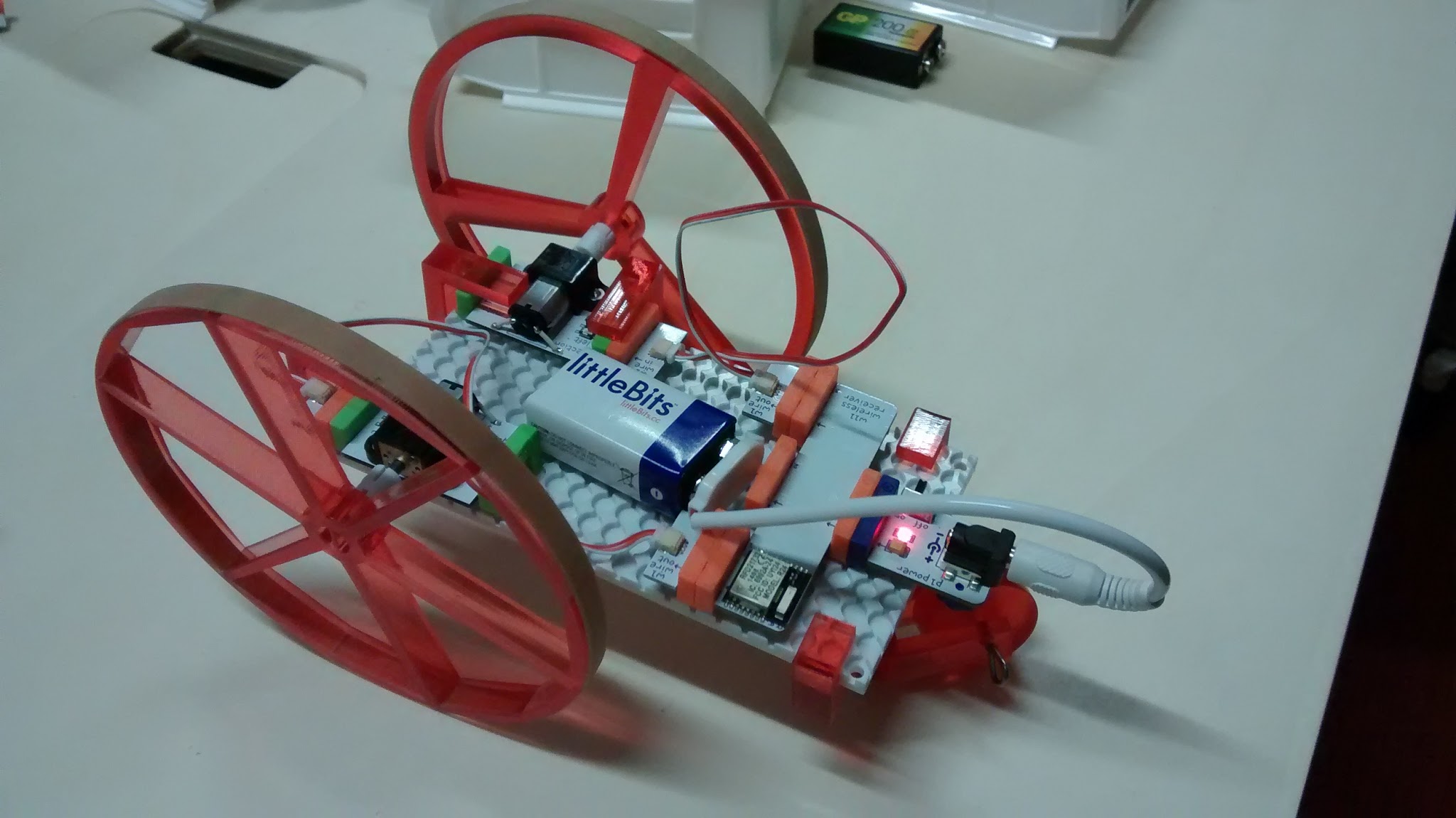
Enjoyed tinkering with LittleBits last evening at the Internet of Things / Open Hardware meetup of RDM Makers and made this remote controlled robot:
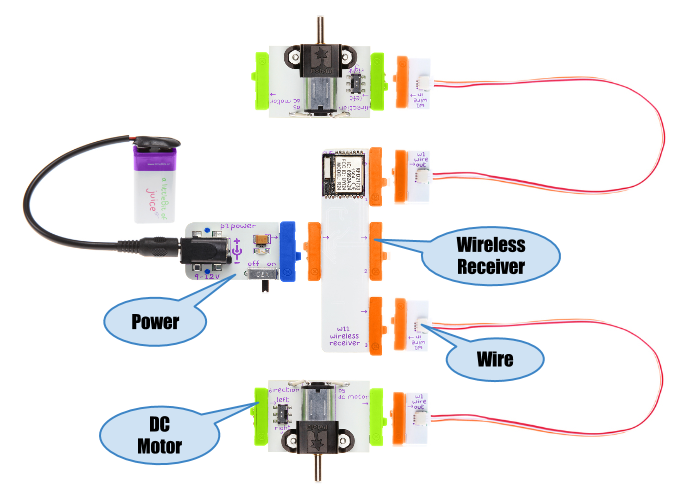
The schematic is more or less like this:
Which shows that power is provided to a Wireless Receiver, which has 2 of its 3 channels connected to the two DC Motors (driving the big wheels). The careful observer will notice some bugs in the schematic representation due to cut-and-paste... However, the real LittleBits only snap together when they can; their plastic frames are like puzzle pieces that will avoid bad connections.
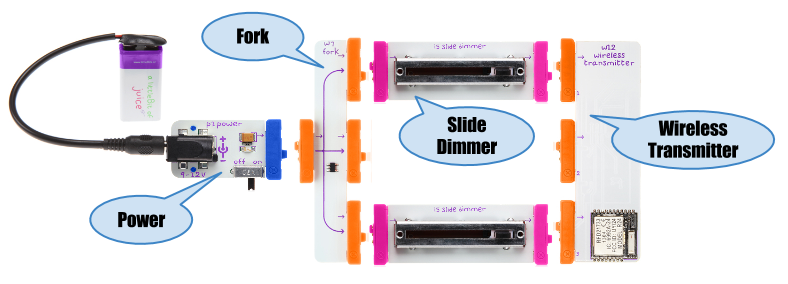
Now, I forgot to take a picture of the set-up that allowed it to be controlled, which actually changed a few times during the evening. A useful configuration was that Power was Fork-ed to two Slide Dimmers, which would feed into 2 of the 3 channels of the Wireless Transmitter:
With each channel corresponding to a DC Motor, this allowed us to run the wheels at different speeds, allowing the robot to go left or right. And go forward with both sliders at the same setting. There was some slider threshold before anything moved, probably sufficient power was needed by the transmitter before it could send any signal.
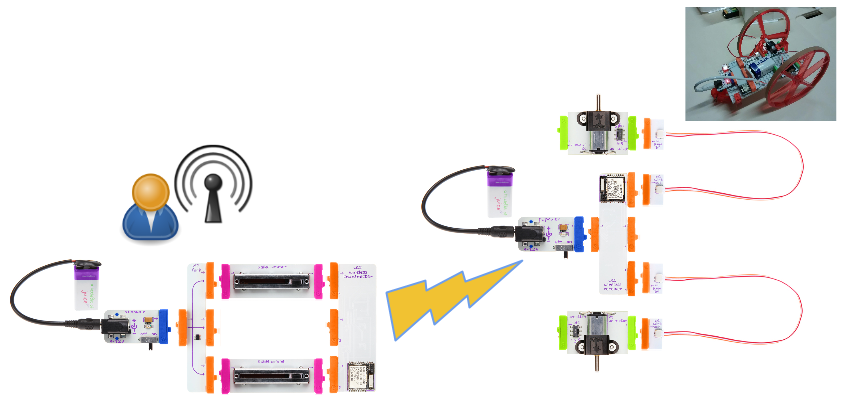
The whole configuration looked something like this:
With the user (on the left) using the sliders to remote control (via a wireless connection) the two motor wheels of the robot. With some parts of the chassis and the wheels actually being laser-cut parts made by
RDM Makerspace; which also provided the library of LittleBits to play with.
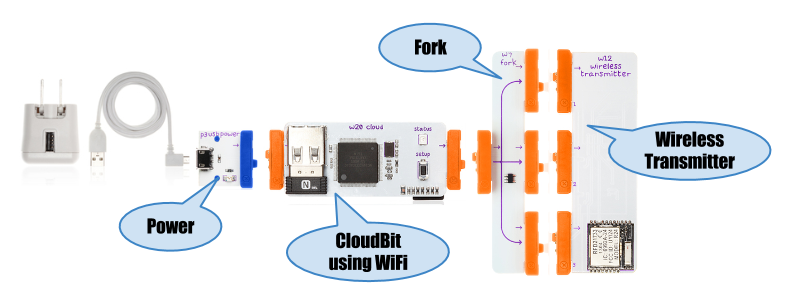
Another part out of that library is the Cloud Bit, that uses WiFi to connect to the internet. We used it to modify the remote control into something that could be activated on-line. Removing the two sliders, the schematic of the remote control unit changed to this:
The drawback of this configuration is that the Cloud Bit only can transmit on/off via the Wireless Transmitter: as the same signal is Fork-ed to all three channels (of which we use two in the robot).
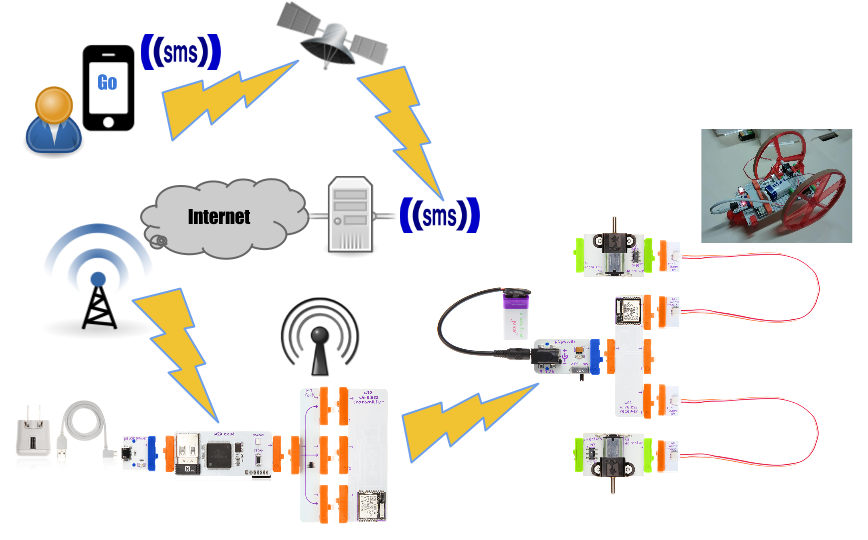
Nevertheless, it makes the whole picture much more... ehh, interesting:
The user will now use his/her mobile phone, to SMS a text message to a specific number in the USA (which is why the satellite is shown... but perhaps it goes over some transatlantic fiber). There the
IFTTT (= if-this-then-that) server receives the SMS and notifies the Cloud Bit over the internet to activate for a couple of seconds. Which puts a signal on all channels of the Wireless Transmitter... and our robot moves forward for the given amount of seconds.
And it actually worked.
Overly complicated? Of course, but fun to build in one workshop of just two-and-a-half hours: which actually included a welcome, visit to the RDM Makerspace machines, introduction to LittleBits, playing - building - registration with IFTT service and SMS relay - and testing!
There was enough time to make a video... but we talked too much ;-)